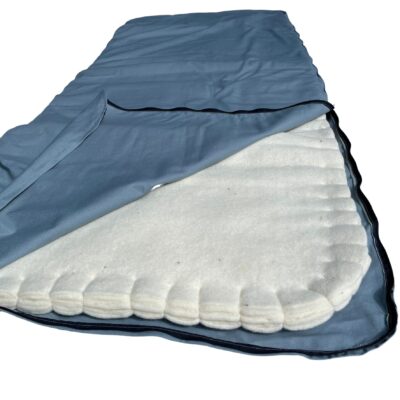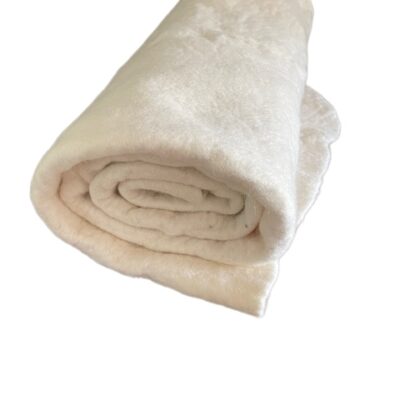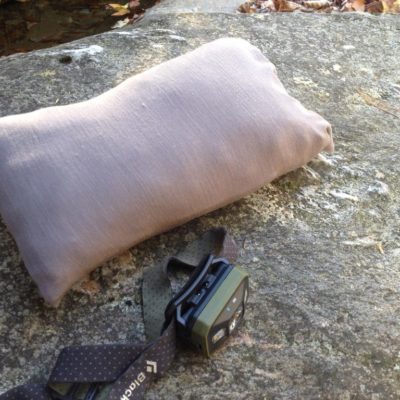

Most people who sleep badly on a camping trip blame the bag. The real problem is usually underneath them: a thin pad on cold, uneven ground, and a body that has never practised sleeping on a hard surface. This guide covers both halves of that problem. It explains what is actually going on when you lie on the floor or the ground, gives you a two-week progression for getting used to it at home, and tells you how much wool felt to put under you for a hardwood floor, a tipi and a backpacking trip.
Why sleeping on a hard surface feels the way it does
Lie down on a firm floor tonight and two things happen. First, the parts of you that normally sink into a mattress (hips, shoulders, the back of the head) meet resistance. Second, every muscle that is holding a little tension makes itself known, because there is nothing under you to disguise it. Ten minutes later, if you let it, most of that tension has gone. That is the whole experience in one paragraph: a hard surface is uncomfortable exactly where you are tight, and comfortable everywhere else.
This is why the floor is the default surface in yoga, Feldenkrais and most bodywork. It gives feedback. On a soft mattress you can lie twisted for eight hours and never notice; on a firm surface you notice in three minutes, shift, and settle into a position where your spine lies in something like its natural curve. Whether that does anything for anyone’s back over the long term is a question for a physiotherapist, not a gear company. What we can say from a few decades of doing it is that it feels better, the feeling grows with practice, and once you have it, the ground on a camping trip stops being an ordeal.
The physiotherapist Michael Tetley spent years documenting how people in cultures without mattresses rest and sleep: on their sides with the legs staggered, on their backs with one knee up, curled around a small rest under the neck. Those positions come up again below, because they are the ones that make a firm surface work.
From mattress to floor to ground: how this started
Our founder started sleeping outside at fifteen, dragging a sleeping bag and a ground cloth onto the lawn of an apartment complex in Lawrence, Kansas, on nights when the grass was covered in dew or frost. It was not about toughness. The question was simpler: why does anyone need a mattress at all? Sand on a beach, a boulder by a creek and the forest floor all turned out to sleep better than the bed at home, so the project became copying those surfaces indoors. The answer, after a lot of experimenting, was almost nothing: a thin pad of felted wool on a wood floor.
Years later a friend called to say she had stretched out on a boulder along a creek, thought of “that crazy method of sleeping on a hard surface”, and found she had relaxed completely and dozed off with nothing under her at all. That is the normal progression. The floor at home trains you for the ground outside, and the ground outside makes the floor at home feel luxurious.
Cold ground: why the pad matters more than the bag
Indoors the surface question is about comfort. Outdoors it is also about heat, and this is where most beginners get it wrong. A sleeping bag keeps you warm by trapping still air in its loft. Under your body, that loft is crushed flat, so the insulation beneath you is close to zero regardless of how good the bag is. Whatever is under you then conducts heat straight out of your back and hips.
The ground is a very large heat sink. Soil a few inches down sits near the average air temperature of the past few weeks, so even in July the earth under a mountain camp can be 50°F, and in the shoulder seasons it is colder than the night air. Damp ground is worse, because water conducts heat far faster than dry soil. A person in a 20°F bag on bare ground at 35°F will be cold; the same person on a decent pad with a 35°F bag will be fine. If you are choosing where to spend money or weight, spend it under you first. Our article on why damp cold feels colder explains the moisture side of this.
Commercial pads are rated with an R-value under ASTM F3340. Lucky Sheep’s felt pads have not been through that test, so we give thickness guidance from field use rather than a number. Dense wool felt insulates well for its thickness because the fibres are packed tight and stay lofted under load, and it keeps insulating when it is damp from ground moisture or condensation, which is the condition that beats most other materials.
How much wool felt to put under you
The organic wool sleeping pad is dense US wool felt inside a removable, machine-washable organic cotton cover. It comes in three thicknesses, and the right one depends on the surface, not on how tough you are.
- ¼ in (one layer, 32 oz at 24 × 76 in, packs to about 6 × 12 × 12 in). The trail pad. Enough on dry, three-season ground and on a wood floor once you are adapted. It also folds into the back panel of the 65 L canvas pack as its frame, so it earns its place twice.
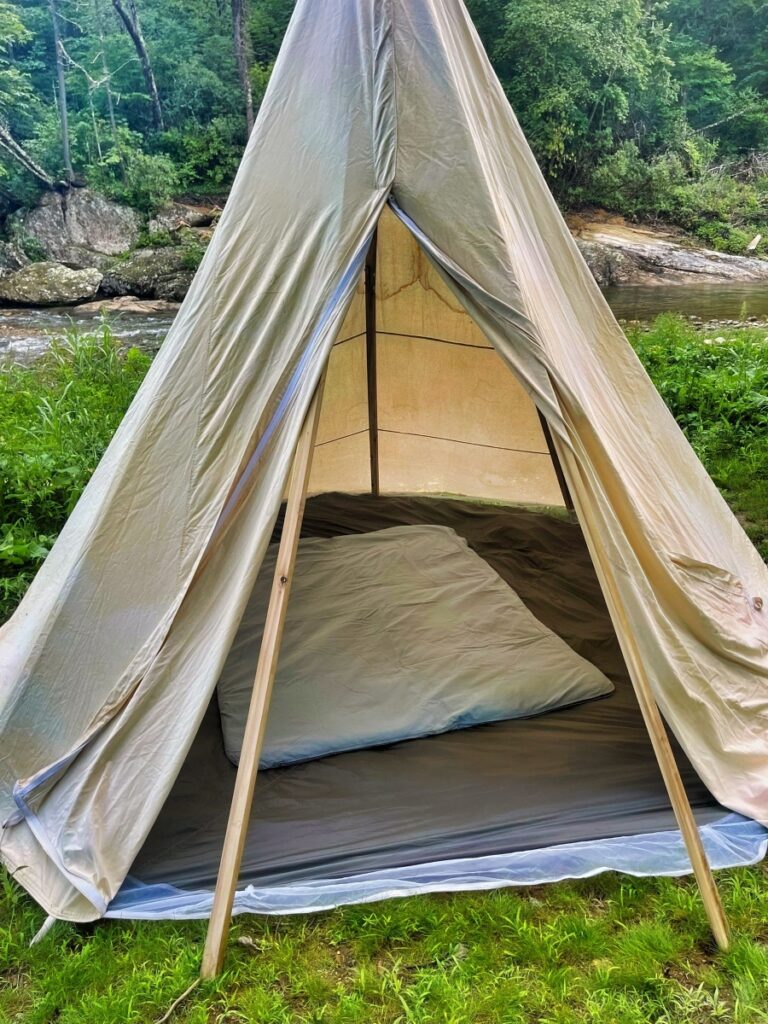
- ¾ in (three layers). Cold or damp ground, tipi and car-camping floors, and the floor at home for people who want a firm surface with a little forgiveness. This is the minimalist’s house pad.
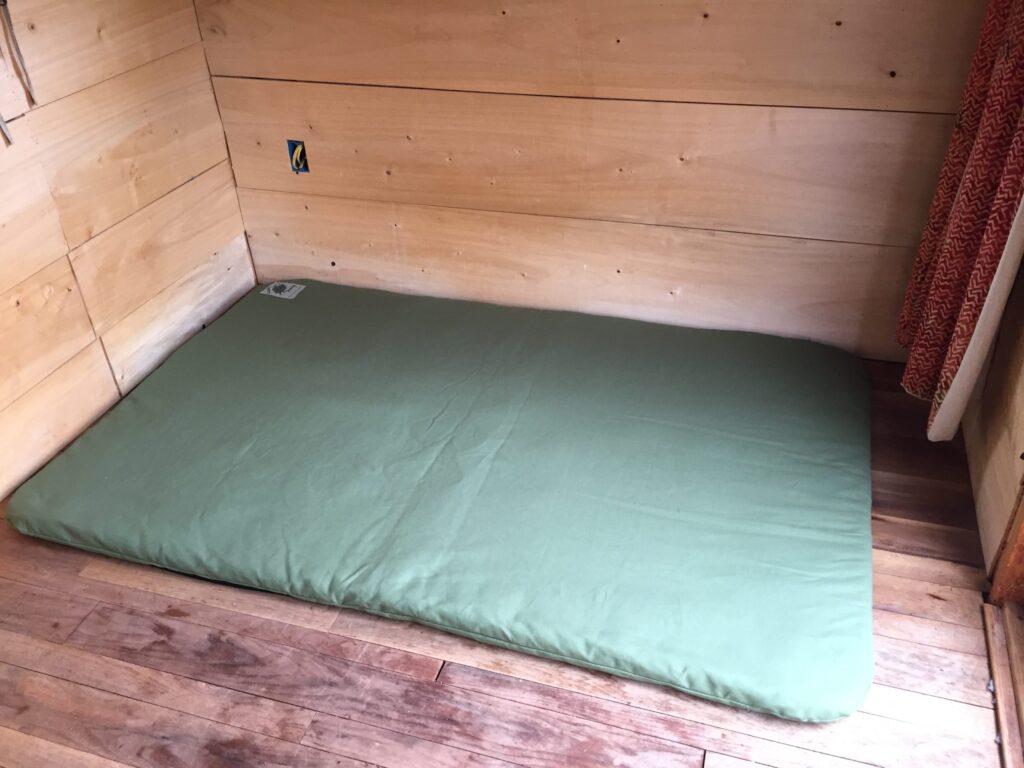
- 1.5 in (six layers). Most people’s floor pad. Firm enough to give the feedback described above, thick enough that hips and shoulders do not complain in the first week, and warm enough for a cabin floor or a winter basecamp. Widths run to 60 in, so it works on a slatted bed frame or as a shared floor bed.
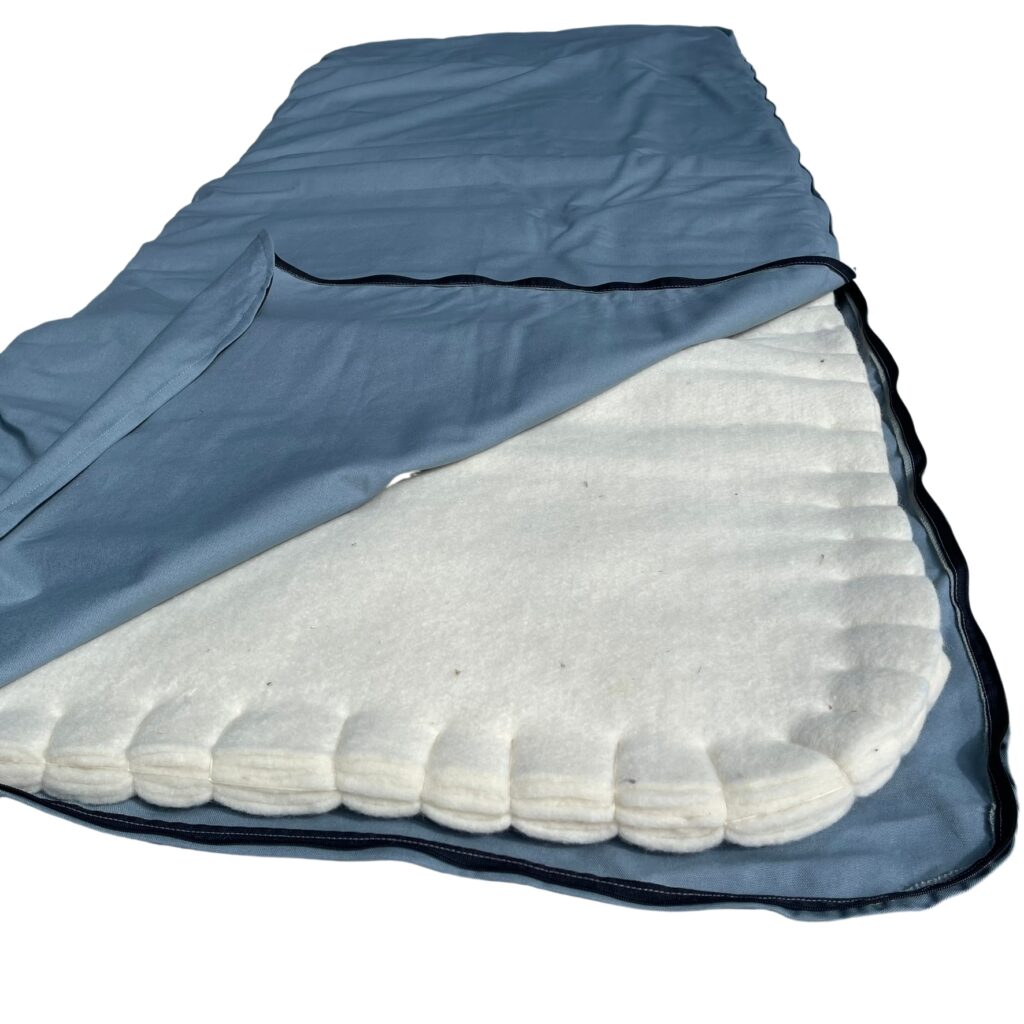
A rule of thumb: on the floor, thickness is about comfort, so start thick and go thinner as you adapt. On the ground, thickness is about heat, so match it to the season and do not go thinner than the ground allows just because your body could take it.
Floor versus tent: the differences that matter
A floor is level, dry and roughly room temperature. The ground is none of those, and each difference calls for an adjustment.
- Level. Indoors you never think about it. Outdoors, sleep with your head slightly uphill (a few inches of rise over your body length is plenty) and clear the sticks and stones before you lay the pad down. Small lumps that you ignore on a mattress are all you feel on a firm pad.
- Dry. Ground moisture moves upward all night. A beeswax cotton ground cloth under the pad keeps it out of the felt and out of your bag.
- Temperature. A hardwood floor over a heated room is not cold. Tile and concrete over a slab are, and behave more like the ground; treat them the same way and add a layer.
- Air. A slatted frame or tatami lets a floor pad breathe from below. On the ground the pad sits on the ground cloth, so stand it up or drape it over the tent in the morning sun to dry the underside.
A two-week progression for learning to sleep on the floor
Going straight from a 12 in mattress to the floor is like throwing away your shoes and running ten miles barefoot. People do it, and most of them quit. The body adapts to a firm surface at the speed of connective tissue, which is slow, so the progression below is deliberately gentle. Keep the bed available the whole time. A full night’s sleep matters more than any gain from sticking it out.
- Days 1–3: ten minutes a day, no sleeping. Lie on your back on the floor on a thin pad or folded blanket, knees bent or a pillow under them, for ten minutes before bed. Notice where you feel the floor. Do nothing about it except breathe.
- Days 4–7: start the night on the floor. Make a pallet with two or three layers (a 1.5 in wool pad, or the ¾ in pad on a folded blanket). Fall asleep there. When you wake up uncomfortable, move to the bed without judgement. Most people last one to three hours the first night and longer each night after.
- Days 8–11: whole nights, same padding. Once you have slept through twice, stay on the floor and stop counting. Keep the pillow under the knees for back sleeping and the staggered-knee position for side sleeping (below).
- Days 12–14: remove one layer. Take the blanket out from under the pad, or move from the 1.5 in pad to the ¾ in if you have both. If a night goes badly, put the layer back for three more nights. Stop at the layer that gives you full nights; there is no prize for thinner.
Two weeks is the typical time to become comfortable on a thick pad. Going all the way to a single ¼ in layer can take six weeks or more, and some people never want to, which is fine; the ¾ in pad is a perfectly good permanent bed. What the two weeks reliably gives you is the ability to lie on a trail pad on the ground and relax rather than fight it.
Positions that work on a firm surface
- On your back: a pillow, rolled jacket or the small camp pillow under the knees takes the strain out of the lower back in the first weeks. Some people prefer a rolled sock or bandana under the small of the back instead. The head rest should be low: support the neck, not the skull.
- On your side: do not stack the knees. Slide the top knee forward of the bottom one so it rests on the pad, or let it drop behind. This spreads the weight off the hip bone, which is the pressure point everyone complains about. A slightly taller pillow than for back sleeping keeps the neck level.
- Change position at each waking. On a firm surface you will surface briefly between sleep cycles. Roll over, resettle, go back down. That is normal, and it is how the surface stops any one spot from taking all the load.
- Getting down and up: kneel, then sit, then lie; reverse it to get up. It takes a few days to feel ordinary and then you stop noticing.
Frequently asked questions
Is it better to sleep on a hard surface?
Better is a medical question we are not qualified to answer, and the honest answer is that it depends on the person. What a firm surface reliably does is give you feedback about how you are lying, which most people find leads to a more relaxed position within a couple of weeks, and it prepares you to sleep well on the ground. If you have a back or joint condition, ask a clinician before changing your bed.
What is the best surface to sleep on?
For most people who want to go firm: a dense wool felt pad, ¾ to 1.5 in thick, on a wood floor, slatted frame or tatami. Wood breathes and sits at room temperature. Carpet is soft in the wrong way and holds moisture; tile and concrete are cold and want an extra layer.
Does sleeping closer to the ground make you colder?
Outdoors, yes, for two reasons: the ground conducts heat out of you, and cold air pools at ground level, especially in meadows and valley bottoms. The fix is a thicker pad and a site a little way up a slope, not a thicker bag. Indoors on a floor over a heated room, the difference is negligible.
How long does it take to get used to sleeping on a hard surface?
About two weeks to sleep full nights on a thick pad, following the progression above. Six weeks or more to be comfortable on a single thin layer. The first three nights are the hardest, and the second week is usually where it turns.
Can I use the wool pad on a bed frame instead of the floor?
Yes. A slatted platform gives the same firm surface with air moving underneath, and it is easier to get in and out of. Order the pad at the frame’s width (24 to 60 in) and skip the mattress.
For the outdoor side of the system (bag, pad, liner, shelter and how they fit together) see How to Sleep Outdoors Naturally, and for a head-to-head of wool felt against foam and inflatable pads, Wool Sleeping Pad vs Foam and Inflatable Pads.
Reviewed August 2026. Comfort and alignment described here are from personal experience, not clinical findings; consult a clinician about any back or joint condition.
A firm, breathable, foam-free place to sleep
Our wool sleeping pad is dense US wool felt in a washable organic cotton cover — a non-toxic sleeping pad for the tent or the floor at home. Pair it with the wool felt bedroll and a camp pillow.
-
Organic Wool Sleeping Pad
Firm, breathable, machine-washable cover
¼ – 1.5 in wool felt24 – 60 in wide
Price range: $150.00 through $1,100.00 Select options This product has multiple variants. The options may be chosen on the product page -
Wool Felt Bedroll Blanket
Blanket, quilt, pad or liner
4 lb / 1.8 kg50 × 76 inUS wool felt
Price range: $275.00 through $325.00 Select options This product has multiple variants. The options may be chosen on the product page