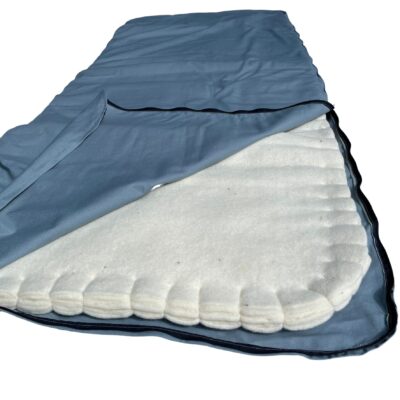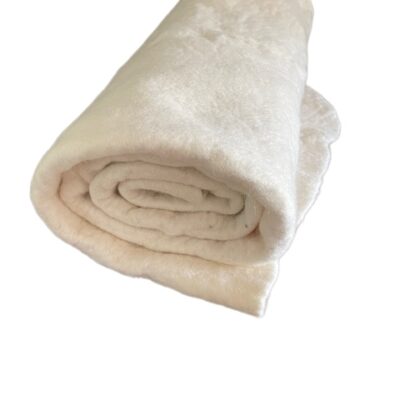
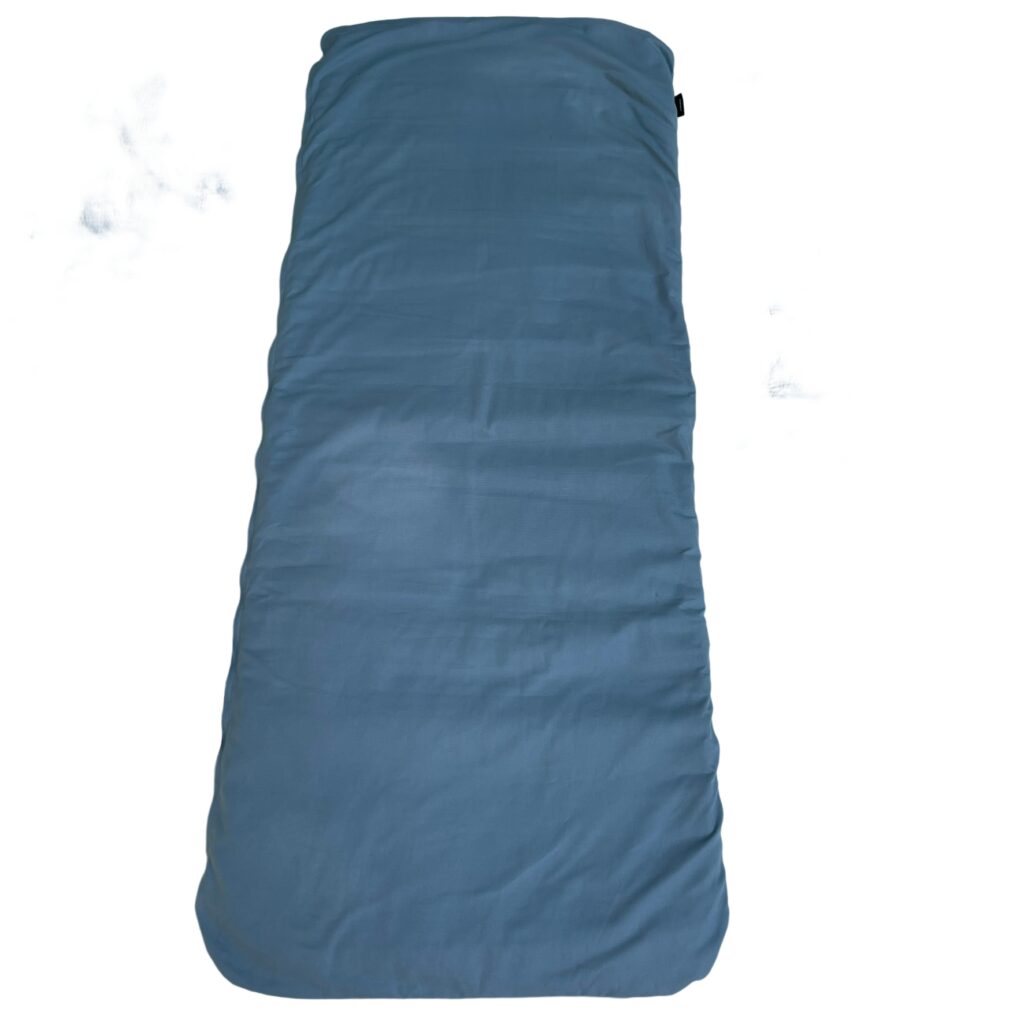
A wool sleeping pad is a slab of dense wool felt in a cotton cover. It does not inflate, it does not crinkle, and it will not fail on the second night of a trip because a spruce needle found the one thin spot. What it costs you is weight and packed size against an inflatable. This article puts the three pad types side by side on the numbers that matter, then explains which thickness of felt to bring for which trip, how to use the pad as a pack frame, and how to look after it.
What a sleeping pad actually does
Two jobs: insulate you from the ground, and give you a surface you can sleep on. The first is the important one outdoors. A sleeping bag’s loft is crushed to nothing under your body, so whatever is beneath you is the only insulation between your back and the earth, and the earth is a heat sink that runs colder than the night air for most of the year. The second job is comfort, and it is where the three pad types differ most in character.
Closed-cell foam pads are light, cheap, indestructible and thin; they insulate reasonably and you feel every root. Inflatables are the comfort-and-packability champions; they are also the only pad that can leave you on the bare ground at 2 a.m. Wool felt sits between them on weight and outside them on feel: firm, quiet, warm to the touch and unaffected by damp.
Wool sleeping pad vs closed-cell foam vs inflatable
Figures for the wool pad are for the Lucky Sheep organic wool sleeping pad; foam and inflatable figures are typical ranges for full-length backpacking pads from published specifications, not any one brand.
| Wool felt ¼ in | Wool felt ¾ in / 1.5 in | Closed-cell foam | Inflatable | |
|---|---|---|---|---|
| Weight class | 32 oz (24 × 76 in) | Three or six layers of felt; basecamp and floor, not for carrying far | 9–16 oz | 12–24 oz |
| Packed size | About 6 × 12 × 12 in folded, or flat in a pack’s back panel | Rolled; car or cabin | Rolled, about 8 × 20 in; usually strapped outside the pack | Smallest; about 4 × 8 in |
| Warmth | Good for its thickness; dense fibre stays lofted under load; keeps insulating when damp | Cold and frozen ground; winter | Moderate; cold on frozen ground | Ranges from summer-only to winter depending on model; drops to nothing if it deflates |
| Feel | Firm and even; the surface described in our firm-surface guide | Firm with give; hips and shoulders forgiven | Thin and hard; you feel roots | Soft and bouncy; some people love it, some feel they are rolling off |
| Puncture / failure | None | None | None | Yes; valves, baffles and pinholes |
| Noise | Silent | Silent | Quiet | Crinkles with every turn |
| Off-gassing | None; wool, cotton, no foam | None | Slight new-foam smell that fades | Polyurethane or TPU smell when new |
| Washability | Cover unzips and machine washes; felt airs out | Same | Wipe down | Wipe down; cannot be submerged |
| Lifespan | Decades; felt does not compress permanently | Decades | Years; compresses and crumbles at the edges | Years; usually ends with a leak |
| Price | $150–1,100 depending on thickness and width | $20–60 | $50–250 | |
Read the weight row honestly. A ¼ in wool pad is two to three times the weight of a foam pad and heavier than most inflatables. If you are counting grams for a thru-hike, that is a real cost and we will not pretend otherwise. What the ounces buy is a pad that cannot fail, makes no noise, has no plastic smell in a warm tent, is warm to lie on the moment you touch it, and still insulates after a week of damp ground and condensation, which is the condition in which foam gets clammy and an inflatable’s internal insulation gets wet.
Which thickness for which trip
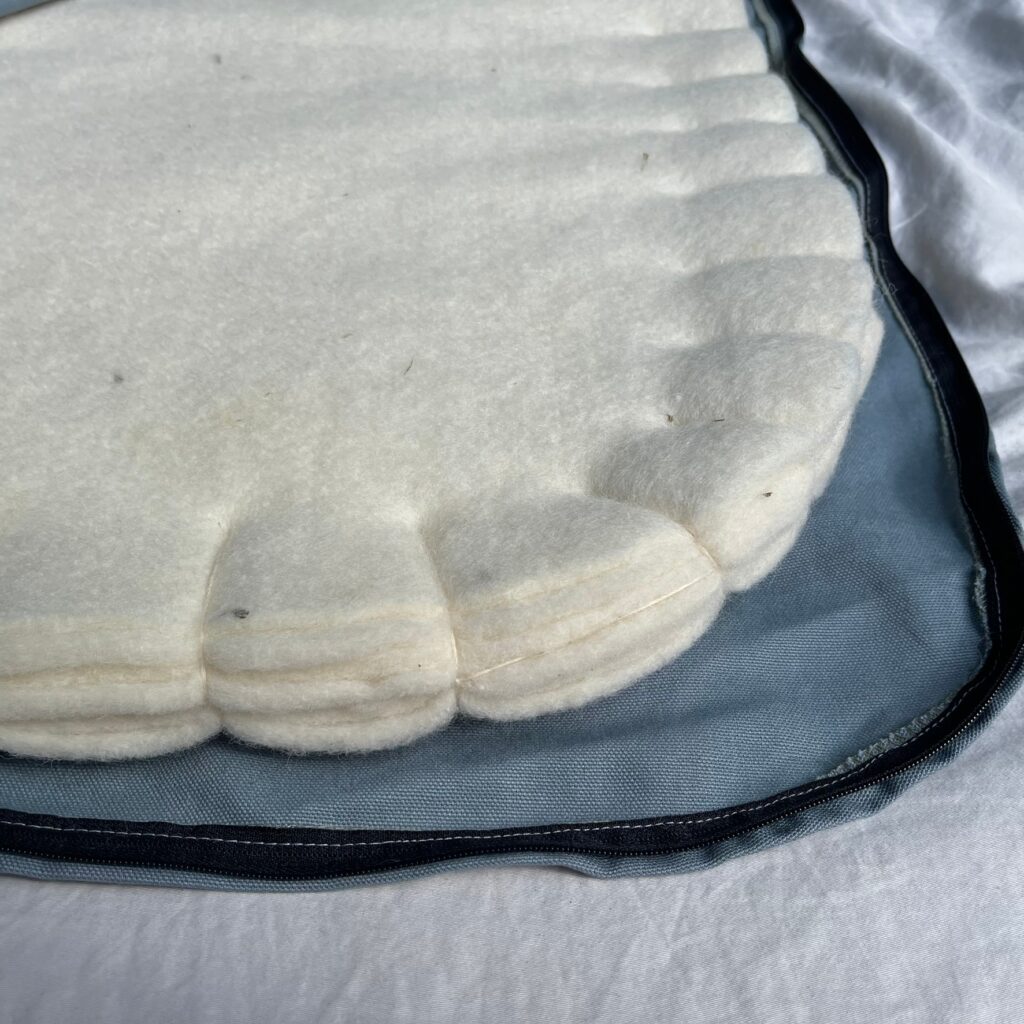
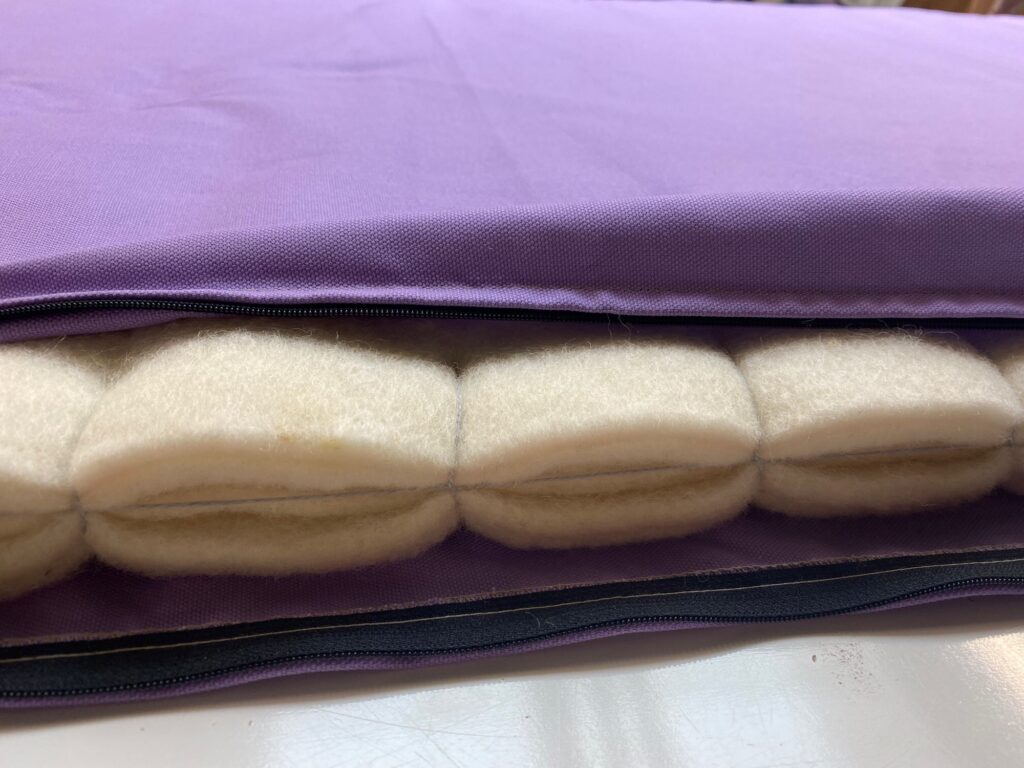
The pad is sold by number of felt layers, which sets both warmth and weight. Widths run from 24 to 60 in.
- ¼ in, one layer. Backpacking from late spring to early autumn on dry ground; the pad you carry. Pair it with the Rewilder and a ground cloth. 32 oz in the 24 × 76 in size, with a 5 oz beeswax twill outer.
- ¾ in, three layers. Shoulder-season and winter camps you drive or paddle to, tipi floors, and the floor at home for minimalists. Enough felt to take the cold out of frozen ground.
- 1.5 in, six layers. Winter basecamp, cabins, and the most popular thickness for a permanent floor bed or a mattress replacement on a slatted frame. Most people who sleep on the floor full-time end up here.
For cold-ground backpacking there is a fourth option: carry the ¼ in wool pad on top of a cheap closed-cell foam pad. The foam takes the frozen ground and the wool gives you the surface. The combination is warmer than either alone and still lighter than the ¾ in pad.
Ground and floor: the same pad, two jobs
Because the felt does not compress permanently and the cover washes, one pad can be a floor bed at home for eleven months and a camp pad for the twelfth. That is how most of ours are used. Indoors it goes on a wood floor, tatami or slatted platform where air can move beneath it; on the ground it goes on a beeswax canvas ground cloth to keep soil moisture out of the felt. The floor at home is also where you train for the ground, and the two-week progression for doing that is in Sleeping on a Firm Surface.
The organic cotton canvas cover is worth a word. It is what you sleep on, so it matters that it is cool to the skin, absorbs a little moisture rather than beading sweat, and does not make a sound. It also means the pad looks like bedding rather than camping equipment, which is why it works in a spare room, a van and a cabin as well as a tent.
The pad as a pack frame
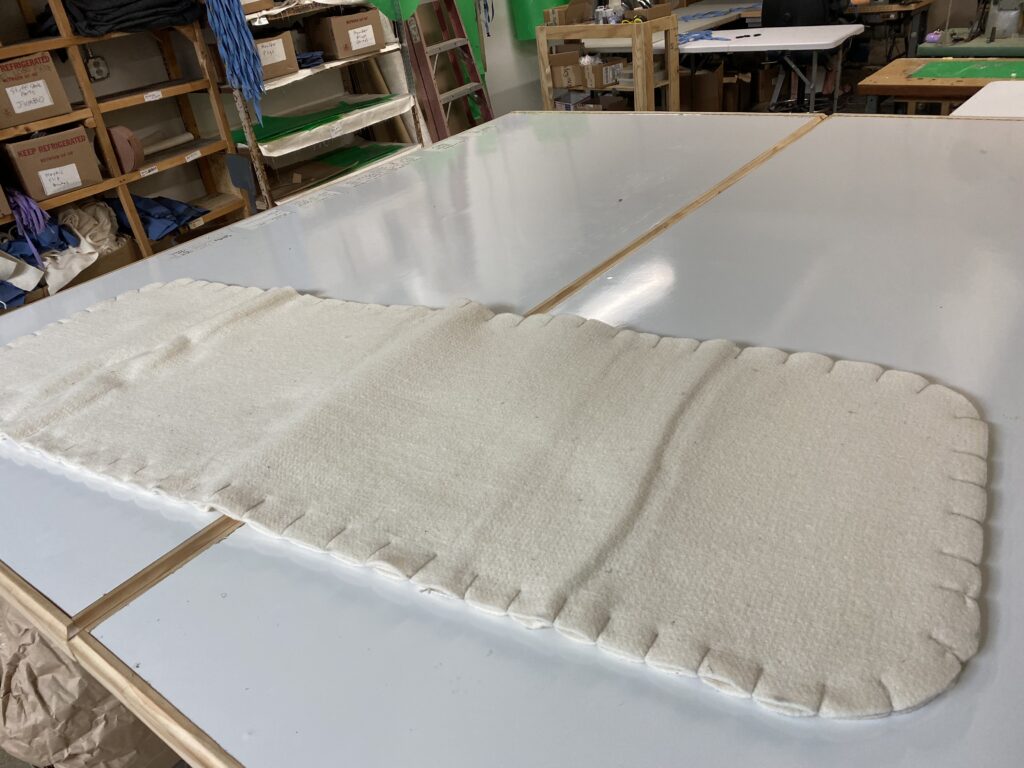
Our 65 L canvas backpack weighs 32 oz because it has no frame. The ¼ in wool pad is the frame. Fold it to the width of the back panel and slide it in against your back, and it stiffens the pack, pads the load and carries no extra weight because you were bringing it anyway. Thru-hikers have done this with foam pads for decades; wool does the same job more quietly and with a pad you would rather sleep on. At camp, pull it out and it is the bed. The technique and the pack are described in our canvas backpack article.
Care
- Cover: unzip, pull the felt out, machine wash the cover warm and hang to dry or tumble on low. A second cover makes laundry day simpler.
- Felt: does not need washing. Air it in the sun a few times a year and after any wet trip; sunlight and airflow deal with odour and moisture. Spot-clean with cold water if needed and let it dry flat.
- On the trail: stand the pad against a tree or lay it on the tent in the morning sun to dry the underside while you eat.
- Storage: flat or loosely rolled, dry, with the cover on. Do not leave it compressed for months; it will recover, but there is no reason to test that.
Who should not buy a wool sleeping pad
If your priority is the lightest possible pack, or you need to sleep in a tiny tent where an inflatable’s small footprint matters, an inflatable is the right tool and a wool pad will frustrate you. If you want a pad that costs $30 and can be strapped to the outside of a pack and forgotten, buy foam. The wool pad is for people who sleep on the floor at home and want the same surface outdoors, who camp in damp climates where everything else gets clammy, who are done with leaking pads, or who want a surface with no foam, no polyurethane and no smell. For them there is no substitute. The whole system it sits under is laid out in How to Sleep Outdoors Naturally.
Reviewed August 2026. Foam and inflatable figures are typical published ranges, not test results; Lucky Sheep pads are not R-value tested.
A firm, breathable, foam-free place to sleep
Our wool sleeping pad is dense US wool felt in a washable organic cotton cover — a non-toxic sleeping pad for the tent or the floor at home. Pair it with the wool felt bedroll and a camp pillow.
-
Organic Wool Sleeping Pad
Firm, breathable, machine-washable cover
¼ – 1.5 in wool felt24 – 60 in wide
Price range: $150.00 through $1,100.00 Select options This product has multiple variants. The options may be chosen on the product page -
Wool Felt Bedroll Blanket
Blanket, quilt, pad or liner
4 lb / 1.8 kg50 × 76 inUS wool felt
Price range: $275.00 through $325.00 Select options This product has multiple variants. The options may be chosen on the product page